
‹
›
‹
›
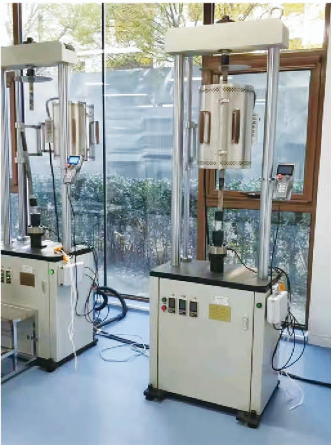
Electronic Creep & Rupture Testing Machine
Overview
The creep and rupture test system is mainly used for tensile, compression, endurance, creep and stress relaxation tests of metallic and non-metallic materials, as well as low-cycle fatigue, creep fatigue and stress corrosion tests. It includes electronic high-temperature creep testing machines, mechanical high-temperature creep rupture testing machines, screw-type fatigue testing machines, slow-strain-rate stress corrosion testing machines and their extended models.
The electronic creep & rupture testing machine is mainly applied to test the mechanical properties of high-temperature alloys, titanium alloys, other ferrous and non-ferrous metallic materials. Besides conventional creep and long-term rupture tests, it can also perform stress relaxation tests, high & low temperature tensile tests, cyclic loading tests (load spectrum tests), low-cycle fatigue tests, etc.
Applicable Standards
JJG276-2009 Verification Regulation for High-Temperature Creep and Rupture Testing Machines
GB/T2039-2012 Metallic Materials — Uniaxial Creep Test Method
ASTM E139-11 Standard Test Methods for Creep, Creep-Rupture, and Stress-Rupture Testing of Metallic Materials
ASTM E328-2013 Standard Test Methods for Stress Relaxation for Materials and Structures
HB5151-1996 Test Method for High-Temperature Tensile Creep of Metals
HB5150-1996 Test Method for High-Temperature Tensile Rupture of Metals
ASTM E2714-2013 Standard Test Method for Creep Fatigue Testing
GB/T15248-2008 Metallic Materials — Axial Constant Amplitude Low-Cycle Fatigue Test Method
Technical Parameters
Creep Testing Machine Accessories
High Temperature Furnace Overview
The split-type atmospheric high-temperature furnace adopts a two-half open structure, with separate control and heating for upper, middle and lower sections. Heating wires of the three sections are arranged on the inner surface of the furnace chamber to form an annular heating cavity, which are controlled by temperature controllers respectively. During heating, thermocouples collect the temperature inside the furnace body in real time.
This high-temperature furnace system mainly consists of high-temperature furnace body, controller, high-temperature tensile fixtures, high-temperature extensometer measuring system and rotating bracket. The temperature control adopts SSR output combined with PID fuzzy control mode with self-tuning function. It communicates with computer via 485 industrial bus module. Operators can set and read the temperature of the controller directly through computer. It features convenient operation, fast heating speed, uniform temperature distribution inside furnace, small test temperature overshoot and high temperature control precision.
Matched with testing machine, this furnace can complete high-temperature tensile tests of various metallic and non-metallic materials. When high-temperature furnace is not required for room-temperature test, the rotating bracket can move the furnace out of the test area.
High Temperature Fixtures Overview
1200℃ High-Temperature Alloy Pull Rod, Fixture and Creep Extension Rod
The fixture is made of premium high-temperature alloy material with reliable performance and long service life. It can operate continuously under high temperature and high stress conditions. Suitable for threaded bar specimens and plate specimens.
Extended application: A middle adapter can be directly added between upper and lower fixtures (hanging fixture), so that two specimens can be tested in parallel.
1600℃ High-Temperature Ceramic Pull Rod, Fixture and Creep Extension Rod
High temperature resistance: Conventional high-temperature alloy fixtures often suffer severe surface oxidation during long-time high-temperature tests. The high-temperature ceramic fixture can work stably at 1600℃ for long hours without oxidation and stable performance.
Low thermal expansion coefficient: Made of high-quality high-temperature ceramic, it ensures minimal thermal deformation of fixtures under high-temperature environment.
Prevent welding between specimen and fixture: Conventional high-temperature alloy fixtures may be welded together with specimens due to high-temperature oxidation during long-time tests. High-temperature ceramic fixtures completely avoid this phenomenon and make the test more convenient and efficient.
If you are interested in our products, please fill in the message below to contact us and get a quote!
We will get back to you as soon as possible!
Type What You are Looking for